The Holy City, Up Close: Four [Historic] Churches Worth Knowing
Charleston is, among many things, a city that builds to last. Its streets hold more than three centuries of accumulated faith expressed in brick, brownstone, stucco, and glass — a collection of sacred architecture spanning denominations, centuries, and stories of survival that few American cities can match. These are buildings earned through fire, earthquake, and endurance, each one still standing, still in use, and still bearing the marks of everything it has outlasted. What follows is a walk through four of my personal favorites in the Holy City — and an invitation to look a little more closely at what they have to say…
St. John the Baptist, Charleston
Some buildings are merely constructed. Others are earned — their stones laid not once but twice, their foundations tested by flame, their spires delayed by a century and a half before finally rising to claim the sky. The Cathedral of St. John the Baptist in Charleston, South Carolina is one of the latter.
A City Grows a Cathedral
The story begins not with grandeur but with pragmatism. On May 3, 1821, the newly appointed Bishop John England — the first Bishop of Charleston — purchased a modest corner lot at Broad and Friend Streets (now Legare), where a simple dwelling house stood. By December of that year, he had blessed it as a temporary chapel, naming it for St. Finbar, the patron saint of Cork, Ireland. A congregation had a home. Now it needed a church worthy of it.
The cornerstone of the first true cathedral was laid at the present site on July 30, 1850. Dedicated to both St. John and St. Finbar, it was consecrated on April 6, 1854 — an antebellum structure of considerable ambition, capable of seating 1,200 worshippers and built at a cost of $103,000. By the standards of the day, it was a statement.
It did not survive the decade.
The Great Fire and the Long Wait
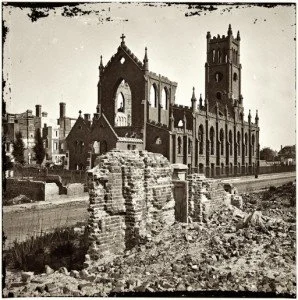
On December 11, 1861, fire broke out on Hasell Street and swept through Charleston with a thoroughness that felt almost biblical. The cathedral burned with the rest. Everything was lost — the building, its furnishings, the accumulated devotion of an entire generation.
What followed was not despair but endurance. Fund-raising continued for the next 45 years, a slow and stubborn act of collective faith. Finally, in January of 1890, the cornerstone of the present Cathedral of St. John the Baptist was laid.
A Gothic Vision in Connecticut Brownstone
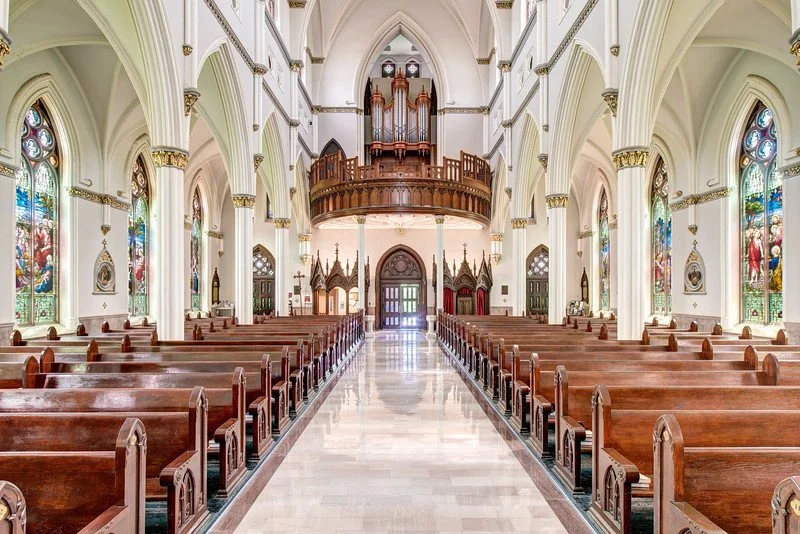
What rose from that cornerstone is one of Charleston's most architecturally distinctive structures. The cathedral was built in the Gothic Revival style and clad in Connecticut tool-chiseled brownstone — a material that gives the exterior its characteristic richness and texture, with deeply cut surfaces that catch light and shadow throughout the day. The Gothic vocabulary is fully committed: pointed arches, soaring nave, clerestory windows, and the bones of a building designed to direct the eye — and the spirit — upward.
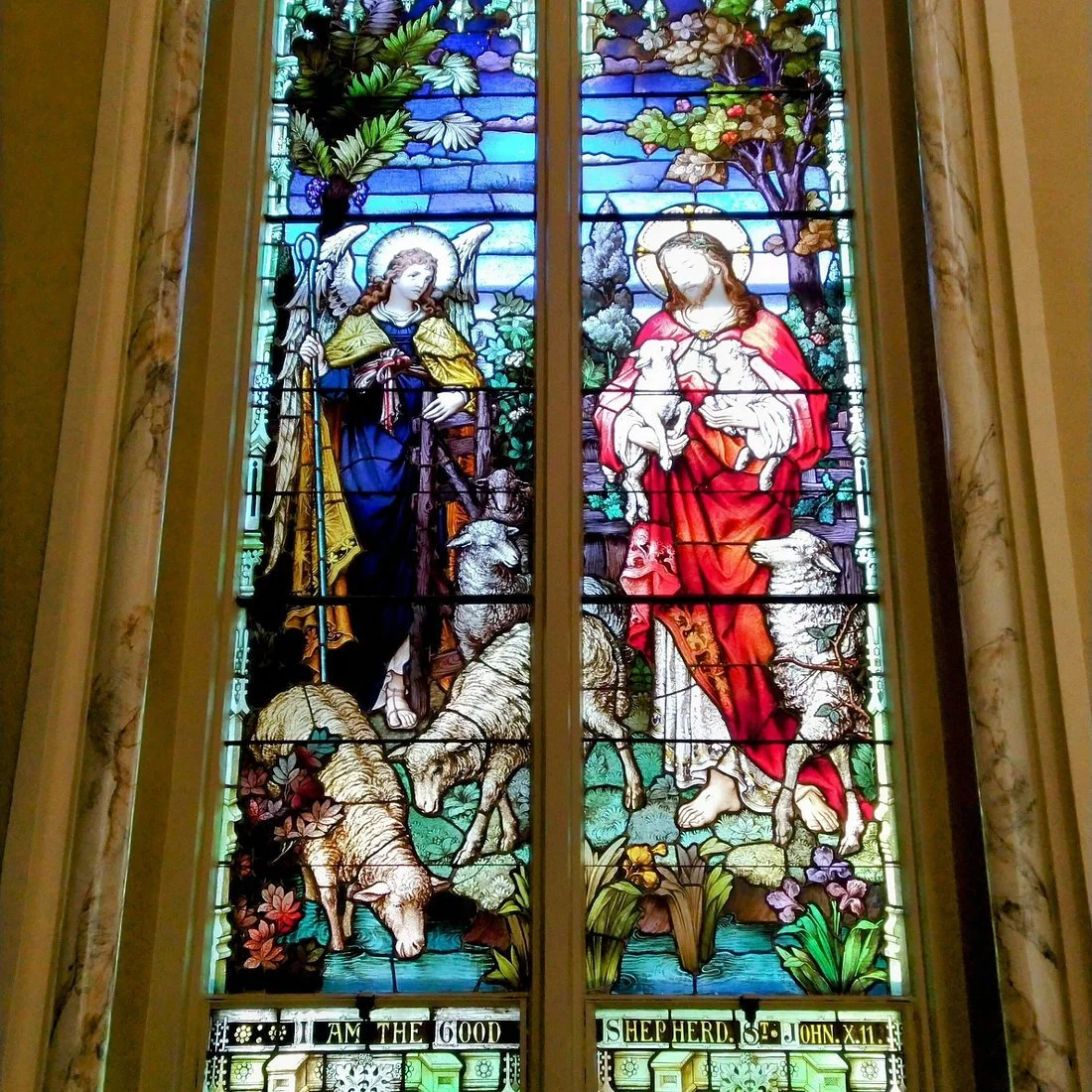
Over each entrance, remarkable stained glass windows frame the threshold: one bearing the Papal coat of arms, another the seal of the State of South Carolina. The juxtaposition is quietly eloquent.
Inside, the pews are of carved Flemish oak, and the three original altars are crafted from white Vermont marble. The nave is defined by 14 large two-light windows tracing the Life of Christ from the Nativity to the Ascension — a narrative in glass that unfolds as you move through the space. Above the high altar, a magnificent five-light window reproduces Leonardo da Vinci's Last Supper, and above that, a rose window depicts the Baptism of Jesus by St. John the Baptist. In the clerestory of the sanctuary, the four evangelists are honored in glass. Below the main floor, the lower church contains a crypt where Bishop England rests — alongside his sister Joanna — and four of Charleston's other bishops.
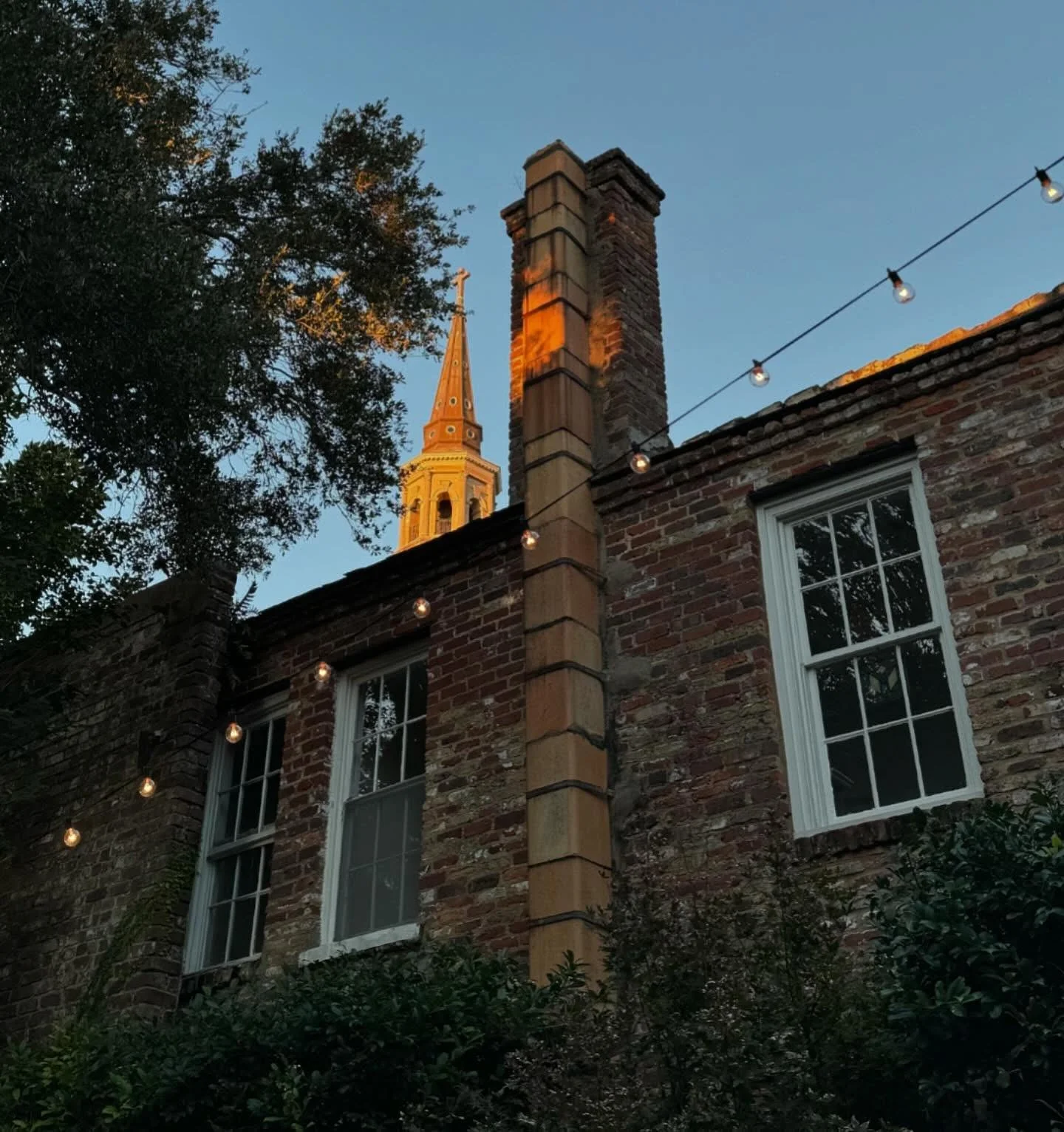
There is one notable absence: the spire. Gothic architecture calls for it, and the original design included one, but the funds never materialized. The tower rose, uncrowned, and remained so for over a century.
Renovation, Renewal, and a Long-Awaited Spire
The cathedral has been tended carefully through the decades. Repairs before the building's 50th anniversary in 1957 addressed structural concerns. Renovations in 1982, initiated by Bishop Ernest L. Unterkoefler for the 75th anniversary, were followed by further commissions under Bishop David B. Thompson in 1991 — a new permanent altar of celebration, a new bishop's chair, and fully renewed furnishings throughout the sanctuary. By 1995, the side walls had been replastered and the entire interior repainted; the color scheme and gold-leafing were chosen to accentuate the Gothic architecture rather than compete with it. A 31-rank French Romantic pipe organ, the Bedient Opus 22, was acquired from Christ Church Cathedral in Louisville, Kentucky, bringing a new voice to the space.
Then, early in the new millennium, something remarkable happened. A committee formed around a campaign called Forward with Faith, aimed at restoring the cathedral's stained glass and exterior stonework. The project grew to include what had been missing since 1890: the steeple, along with three bells to proclaim the presence of God in the surrounding city.
A diocesan-wide appeal — Our Heritage, Our Hope — funded half the cost. The generosity of South Carolina's Catholics, the cathedral's own parishioners, and its many visitors did the rest. One hundred and three years after it was first planned, the spire rose over Charleston.
The Only Catholic Cathedral in South Carolina
The Cathedral of St. John the Baptist stands as the sole Catholic cathedral in the state — a fact that carries a particular weight in a city as layered and history-conscious as Charleston. Its brownstone walls have absorbed more than a century of salt air, sunlight, and the quiet devotion of thousands. The foundation beneath it, still the same one laid in 1854, has now outlasted fire, war, and a century of deferred dreams.
The spire, finally complete, pierces the Charleston skyline not as an afterthought but as a completion — a long-overdue sentence brought at last to its natural end.
Located at 120 Broad St, Charleston, SC 29401
Kahal Kadosh Beth Elohim: A Greek Revival Landmark on Hasell Street
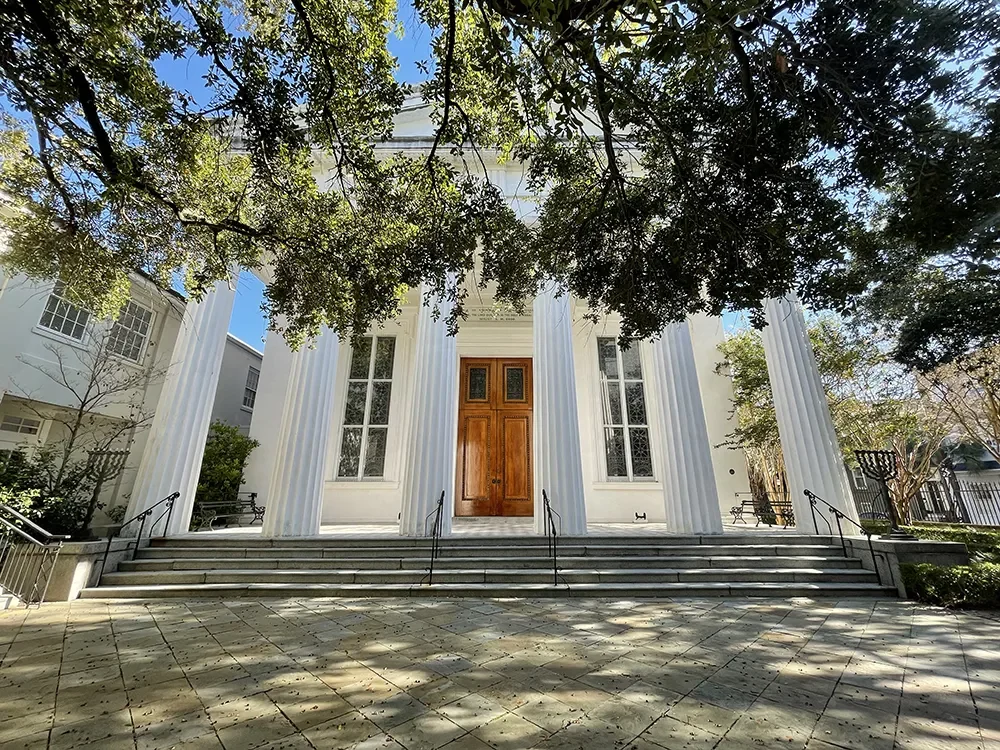
At 90 Hasell Street, set back from the street behind a dignified forecourt, stands one of the most architecturally significant religious buildings in the American South. Kahal Kadosh Beth Elohim — Hebrew for Holy Congregation House of God— is the second oldest synagogue building in the United States and the oldest still in continuous use. Its Greek Revival façade is among the most refined examples of that style in Charleston, a city not short on architectural ambition.
A Congregation Before Its Building
The congregation itself predates the present structure by nearly a century. Founded in 1749 by Sephardic Jews of Spanish and Portuguese origin who had arrived in Charleston from London, Kahal Kadosh Beth Elohim worshipped first in a Georgian Revival synagogue completed in 1793–1794. That building served the congregation for more than four decades before the fire of 1838 swept through Charleston's central business district, consuming some 500 properties across roughly 150 acres. The synagogue did not survive it.
What rose in its place would prove more enduring.
The Architecture of the Present Building
The current synagogue was completed in 1840, designed by architect Cyrus L. Warner and constructed under the supervision of contractor David Lopez Jr. It is a single-story brick structure set on a raised granite foundation — a detail that lends the building a quiet authority from the street, elevating it just enough above grade to signal permanence.
The brick exterior is stuccoed and painted white, then scored to resemble cut stone blocks, a common Greek Revival technique that achieves the visual weight of masonry while working within the practical constraints of brick construction. The effect is crisp and formal, the surface reading as monolithic in strong Charleston sunlight.
The defining feature of the façade is its portico: six fluted Doric columns, equally spaced, rendered in stucco over molded brick and approximating a Theseion order. The columns support a clean gabled pediment, completing a composition that is restrained, symmetrical, and unmistakably Greek in its proportions. The Theseion reference is deliberate — the Temple of Hephaestus in Athens, one of the best-preserved ancient Greek temples, was a touchstone for American Greek Revival architects seeking both archaeological authenticity and civic dignity.
The orientation is south-facing, drawing the main façade toward the street with full effect.
National Recognition
The building was added to the National Register of Historic Places in 1978 and designated a National Historic Landmark in 1980 — recognitions that reflect both its architectural distinction and its broader cultural significance as the home of one of the oldest Jewish congregations in the United States. The congregation's Coming Street Cemetery, separately listed on the National Register, holds the additional distinction of being the oldest continually operating Jewish cemetery in the country.
Together, the synagogue and its cemetery represent a layered and continuous presence in Charleston's urban and religious landscape — one that stretches back nearly three centuries and is still very much alive.
Located at 90 Hassell St, Charleston, SC 29401
Mother Emanuel AME Church: A Gothic Revival Witness on Calhoun Street
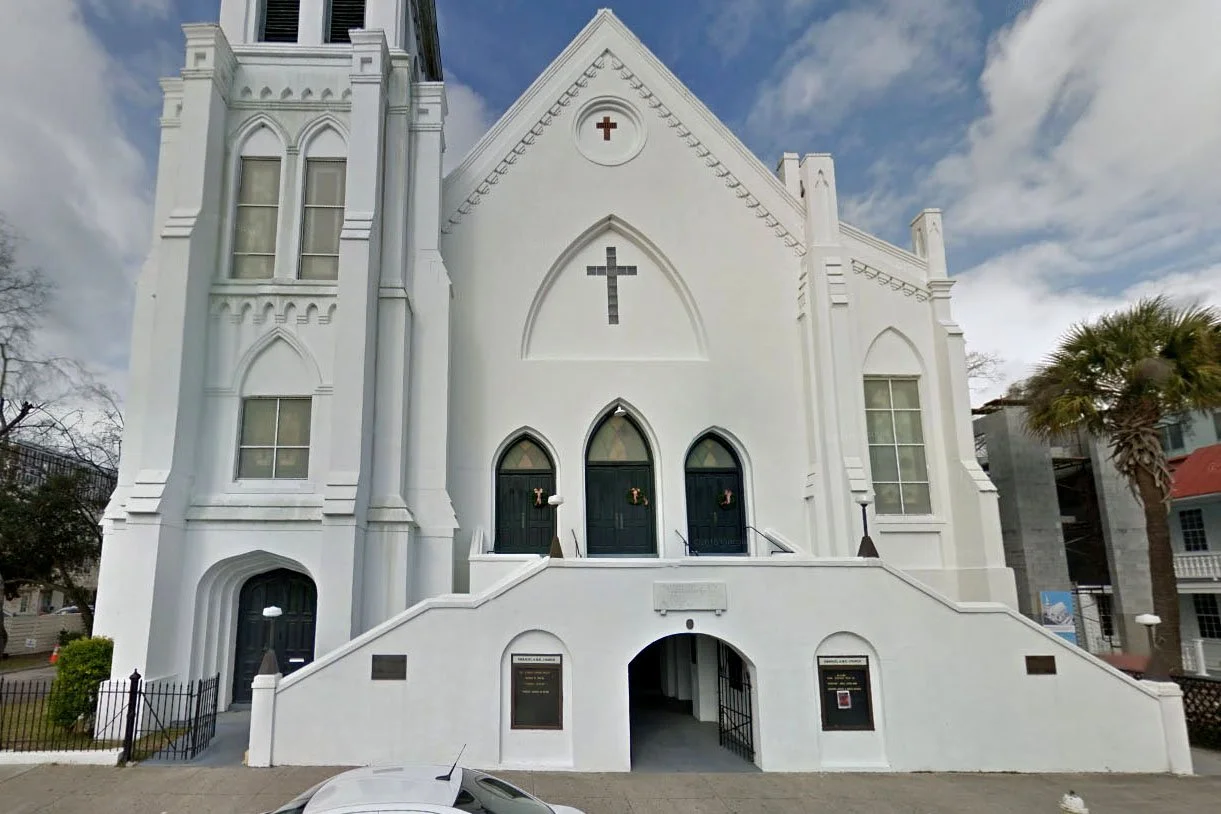
At 110 Calhoun Street in downtown Charleston, Emanuel African Methodist Episcopal Church rises as one of the most historically layered buildings in the American South. Known universally as Mother Emanuel, it is the oldest AME church in the Southern United States and home to one of the oldest Black congregations in the country. The present building, completed in 1891 and designed by prominent Charleston architect John Henry Devereux, is a Gothic Revival structure of brick and stucco — and one of the rare historic churches in the region that has retained its original interior largely intact.
A Congregation Built and Rebuilt
The congregation's history runs deep beneath the current structure. Organized as early as 1817 under the leadership of the Reverend Morris Brown, it drew nearly 2,000 Black members from Charleston's Methodist Episcopal churches before running headlong into the city's repressive ordinances. The original church was burned by a white mob in 1822, following the discovery of an alleged slave rebellion plot organized by Denmark Vesey, one of the church's own founders. After decades of secret worship — all-Black churches were outlawed outright in 1834 — the congregation reorganized openly after the Civil War and rebuilt between 1865 and 1872 as a wooden structure. That building was destroyed in the great Charleston earthquake of 1886.
The present church is thus the third iteration of a congregation that has refused, repeatedly, to cease to exist.
The 1891 Building
Construction began in the spring of 1891 under Devereux's direction and was completed in 1892. The building sits on the north side of Calhoun Street — a geographic reality that carried social weight at the time, as Black residents were unwelcome on the street's south side. The choice of Gothic Revival for the design was significant: in the late nineteenth century, Gothic architecture carried associations of permanence, spiritual authority, and institutional dignity — qualities a congregation that had survived suppression, arson, and earthquake had every reason to claim.
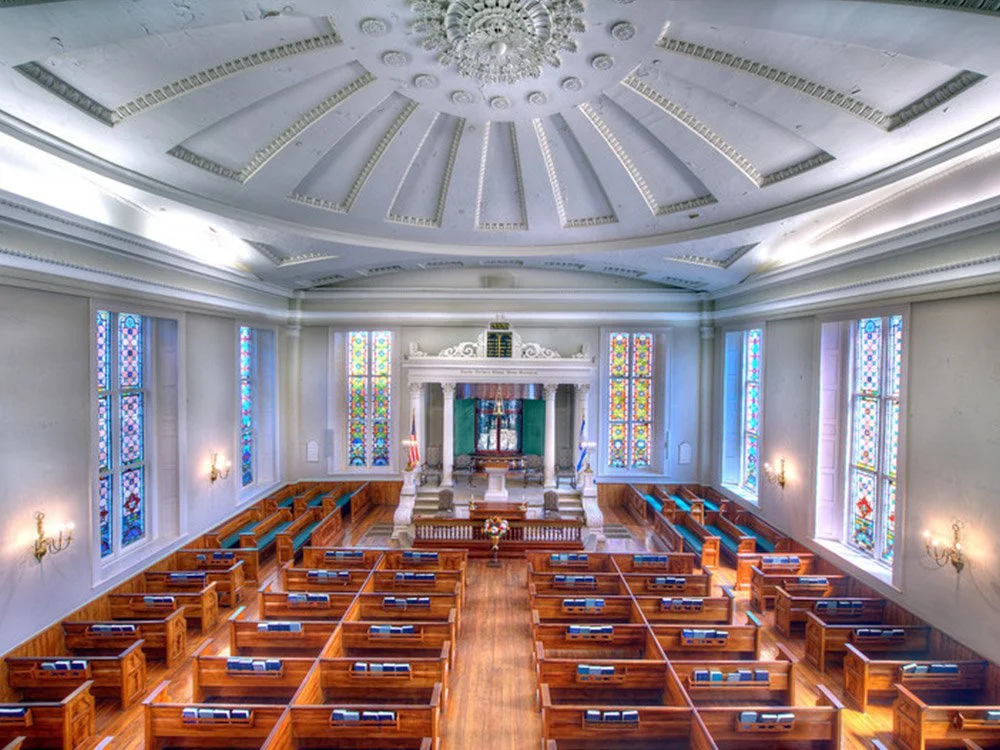
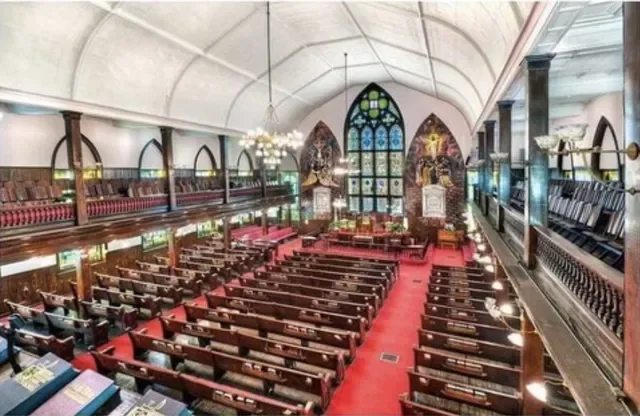
The exterior is brick and stucco, with Gothic detailing expressed through the massing and fenestration. Inside, the church has a capacity of 2,500, making it among the largest historically Black churches in Charleston. What distinguishes the interior above all is its exceptional state of preservation: the original altar, communion rail, pews, and light fixtures remain in place, a continuity of material culture that is increasingly rare in active historic congregations. A pipe organ was installed in 1902, adding its own layer to the building's accumulated history. The tin roof, damaged in Hurricane Hugo in 1989, was later replaced with interlocking copper shingles — a material that will patina over time, reading as both a repair and a continuation.
A Living Landmark
The building was listed on the National Register of Historic Places in 2018, a recognition long overdue for a structure of its age, integrity, and significance. On June 17, 2015, Mother Emanuel became the site of an act of racial terror when a white supremacist opened fire during a Wednesday evening Bible study, killing nine members of the congregation — among them the senior pastor and South Carolina State Senator Clementa Pinckney. The building absorbed that grief as it has absorbed so much else, and the congregation has continued to gather within it.
A permanent memorial to the Emanuel Nine is currently being designed by the architect responsible for the National September 11 Memorial in New York City — an acknowledgment that what happened here belongs to a history larger than any single city.
Gothic Revival in the American South: What the Style Meant and Why It Mattered
To understand why Emanuel AME's 1891 building carries the weight it does, it helps to understand what Gothic Revival architecture meant in nineteenth-century America — and what it meant specifically for a Black congregation in the post-Reconstruction South.
The Style and Its Origins
Gothic Revival emerged in England in the late eighteenth century as a romantic reaction against the cool rationalism of Neoclassical architecture. Where Greek and Roman Revival buildings spoke the language of democracy, civic order, and Enlightenment reason, Gothic architecture reached further back — to the soaring cathedrals of medieval Europe, with their pointed arches, ribbed vaulting, clustered columns, and windows designed to dissolve solid walls into light. The style was, at its heart, about aspiration: the vertical thrust of a Gothic building was understood as a literal and spiritual reaching toward heaven.
By the mid-nineteenth century, Gothic Revival had become the dominant vocabulary for church architecture across the English-speaking world, driven in large part by the influence of the English architect Augustus Pugin and, in America, by the prolific ecclesiastical designer James Renwick Jr., whose Saint Patrick's Cathedral in New York City — begun in 1858 — fixed Gothic Revival as the prestige language of American religious building. The style conveyed antiquity, permanence, and sacred purpose. For any congregation seeking to announce its legitimacy and rootedness, Gothic was the architectural argument to make.
Gothic Revival in Charleston
Charleston had its own robust tradition of Gothic Revival ecclesiastical architecture. The Cathedral of St. John the Baptist, built in Connecticut tool-chiseled brownstone beginning in 1890, is among the city's most fully realized examples of the style. Grace Episcopal Church on Wentworth Street and St. Matthew's German Evangelical Lutheran Church on King Street — the latter with its soaring steeple long one of the tallest structures in the city — further established Gothic as the language of institutional religious permanence in the Charleston streetscape.
It was into this context that architect John Henry Devereux placed Emanuel AME's design. Devereux was one of the leading architects practicing in Charleston in the late nineteenth century, and his choice of Gothic Revival for the commission was not incidental. It was a declaration.
What the Style Said for This Congregation
For a Black congregation in 1891 Charleston — one that had been burned out, legislated out of existence, forced underground for decades, and was now rebuilding in the immediate aftermath of both the Civil War and a catastrophic earthquake — the selection of Gothic Revival carried a specific and pointed meaning. This was not a provisional building. It was not a modest structure designed to avoid attracting attention. It was a church built in the same architectural language as the most prestigious religious institutions in the city and the nation.
The pointed arches, the verticality, the formal massing — all of it communicated what the congregation had been insisting for the better part of a century: that this was a community of faith with roots, with continuity, and with a claim on the permanent fabric of the city. In the South of 1891, where Reconstruction had collapsed and Jim Crow was hardening into law, that claim was not a small thing to make in stone and mortar.
The building's placement on the north side of Calhoun Street — on the Black side of what had functioned as a racial boundary line in Charleston — made the architectural statement even more deliberate. Gothic Revival had long been the architecture of institutional authority. Mother Emanuel was building its own.
Preservation as Continuation
That the interior has survived so completely — original pews, altar, communion rail, light fixtures — adds another layer to the Gothic Revival argument. Gothic architecture was always partly about duration, about the idea that what is built with sufficient care and faith outlasts the moment of its making. Mother Emanuel's interior, largely unchanged since 1891, embodies exactly that. The building has not merely survived its history. It has held it.
Located at 110 Calhoun St, Charleston, SC 29401
The French Huguenot Church: Charleston's Oldest Gothic Revival Building
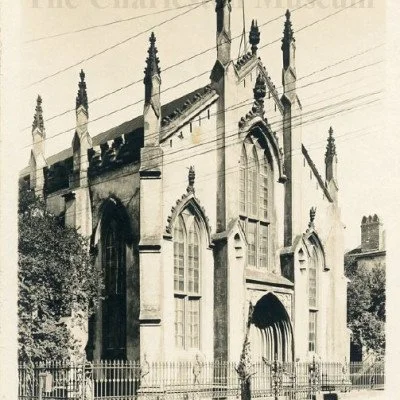
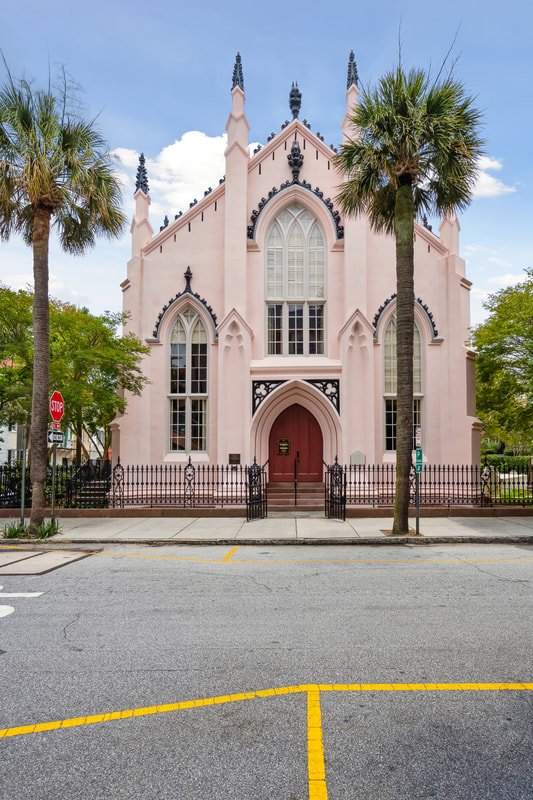
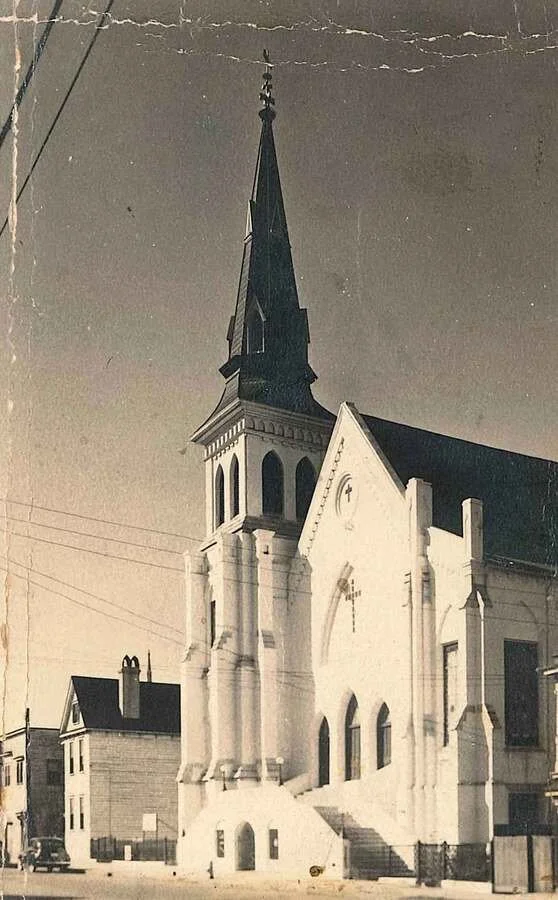
At 136 Church Street, tucked into the neighborhood Charleston has called its French Quarter since 1973, stands a building that holds a quiet but significant distinction: the oldest Gothic Revival church in South Carolina. The French Huguenot Church — completed in 1845, designated a National Historic Landmark, and listed on the National Register of Historic Places — is a small building by cathedral standards, but architecturally it punches well above its size.
The Architect and His Moment
The church was designed by Edward Brickell White, one of the most versatile and accomplished architects practicing in antebellum Charleston. White was equally fluent in the classical vocabularies — his other commissions include Market Hall on Meeting Street, the steeple of St. Philip's Episcopal Church, and St. Matthew's German Evangelical Lutheran Church — which makes his choice of Gothic Revival for the Huguenot Church all the more deliberate. By 1844, Gothic Revival was rapidly becoming the preferred style for Protestant church architecture in America, championed by ecclesiologists who argued that pointed arches and vertical massing were inherently more spiritually expressive than the horizontal calm of Greek and Roman forms. White was clearly paying attention.
Construction was carried out by local contractor Ephraim Curtis, and the building was completed in 1845 — predating by several decades the wave of Gothic Revival churches that would reshape Charleston's ecclesiastical landscape after the Civil War.
Reading the Exterior
The church is a stuccoed brick structure, three bays wide and six bays long — a compact, well-proportioned rectangle that wears its Gothic ornament with considerable elegance. The rhythm of the façade is established by narrow buttresses that divide each bay, rising to elaborate pinnacles at the roofline. Buttresses in Gothic architecture serve a structural purpose — transferring the lateral thrust of vaulted interiors to the exterior walls — but here they function primarily as compositional elements, giving the building its characteristic verticality and cadence.
The three front windows are finished with cast-iron crockets — the hooked, leaf-shaped ornaments that crawl up the edges of Gothic arches and gables — a detail that speaks to the period's enthusiasm for decorative ironwork as much as to Gothic precedent. Above everything runs a battlement parapet, the crenellated crown more associated with medieval fortifications than with houses of worship, but thoroughly at home in the Gothic Revival idiom, where the boundaries between castle, cathedral, and cottage were deliberately blurred.
The overall effect is of a building that is at once modest in scale and richly detailed — more English country church than French cathedral, which suits both the congregation's history and Church Street's intimate urban character.
The Interior
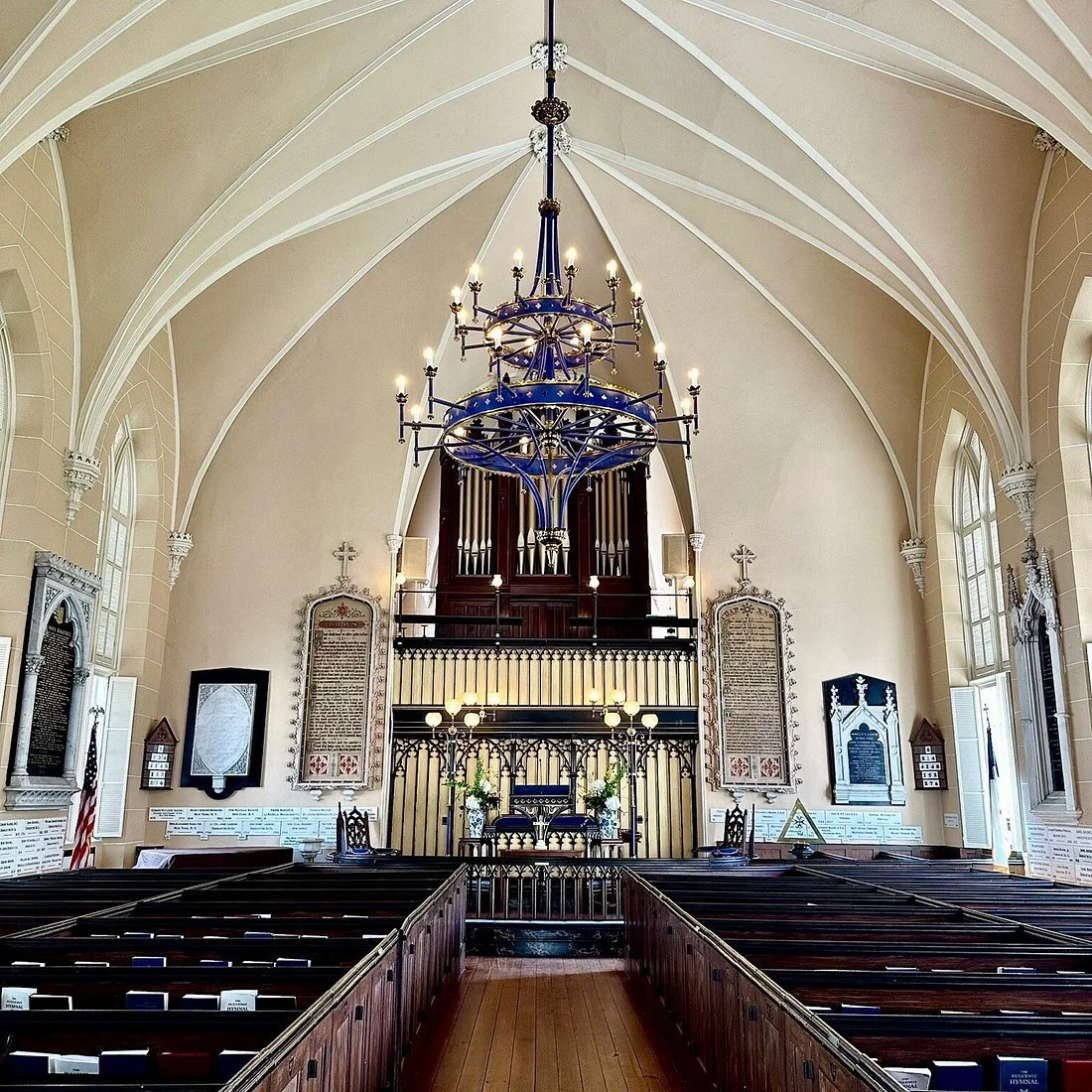
Inside, the walls give way to plaster ribbed and grained vaulting — a surface treatment that evokes the stone fan vaulting of English Gothic interiors while working within the practical realities of a mid-nineteenth-century American building budget. The ribs articulate the ceiling into bays that echo the structural rhythm of the exterior buttresses, creating a coherent spatial logic that moves from outside to inside with architectural consistency.
Marble tablets etched with the names of Huguenot families line the walls — a memorial program that integrates history directly into the building's fabric, making the interior simultaneously a place of worship and a record of the congregation's lineage.
The organ deserves particular mention. Purchased in 1845 and built by New York organ maker Henry Erben, it is a tracker organ — a mechanism in which a direct physical connection of wooden trackers links each key to its corresponding pipe valve, producing a responsiveness and tonal immediacy that pneumatic and electric systems cannot replicate. The resulting sound is closely related to the organs of the Baroque period, an acoustic that suits an interior of this scale and character with uncommon precision.
A Building That Has Held
The church sustained damage during both the Civil War and the 1886 Charleston earthquake, and was restored with funds provided by Charles Lanier, a descendant of the original Huguenot families. That it has come through those events — and more than a century of irregular use — with its essential character intact is a testament both to the quality of White's original construction and to the stewardship of those who have cared for it since.
The surrounding graveyard, where generations of Huguenot families are buried, completes the composition: a building, its dead, and the long French Quarter street that has sheltered both for the better part of three and a half centuries.
Located at 136 Church St, Charleston, SC 29401