More Than a Tower: Discovering Pisa’s Culture
Pisa is a city renowned for its iconic landmarks, rich history, and vibrant culture. Once a thriving Roman port sitting on the coast until the 15th century, Pisa now lies on the alluvial plain of the Arno River, about 10 kilometers from the Ligurian Sea. The city has seen much disruption since Roman times, from medieval sea battles to land conflicts between Tuscan rivals Lucca and Florence, and suffered severe damage during World War II. Today, Pisa is a popular tourist destination, with the city's unique Piazza dei Miracoli (The Square of Miracles), a UNESCO World Heritage site, home to Pisa's iconic Leaning Tower.
Must-See Attractions in Pisa Italy: Piazza dei Miracoli
Piazza dei Miracoli, translated as the Square of Miracles or Piazza of Miracles, constitutes one of Italy's most celebrated architectural ensembles and stands as the monumental heart of Pisa, Tuscany. The name itself—coined by Italian writer Gabriele d'Annunzio in the early 20th century—reflects the almost miraculous harmony achieved by its collection of sacred buildings.
Designated as a UNESCO World Heritage Site in 1987, the piazza represents the zenith of Pisan Romanesque architecture and urban planning. The complex attracts millions of international visitors annually, drawn by its extraordinary aesthetic unity and historical importance as a center of medieval religious and civic life.
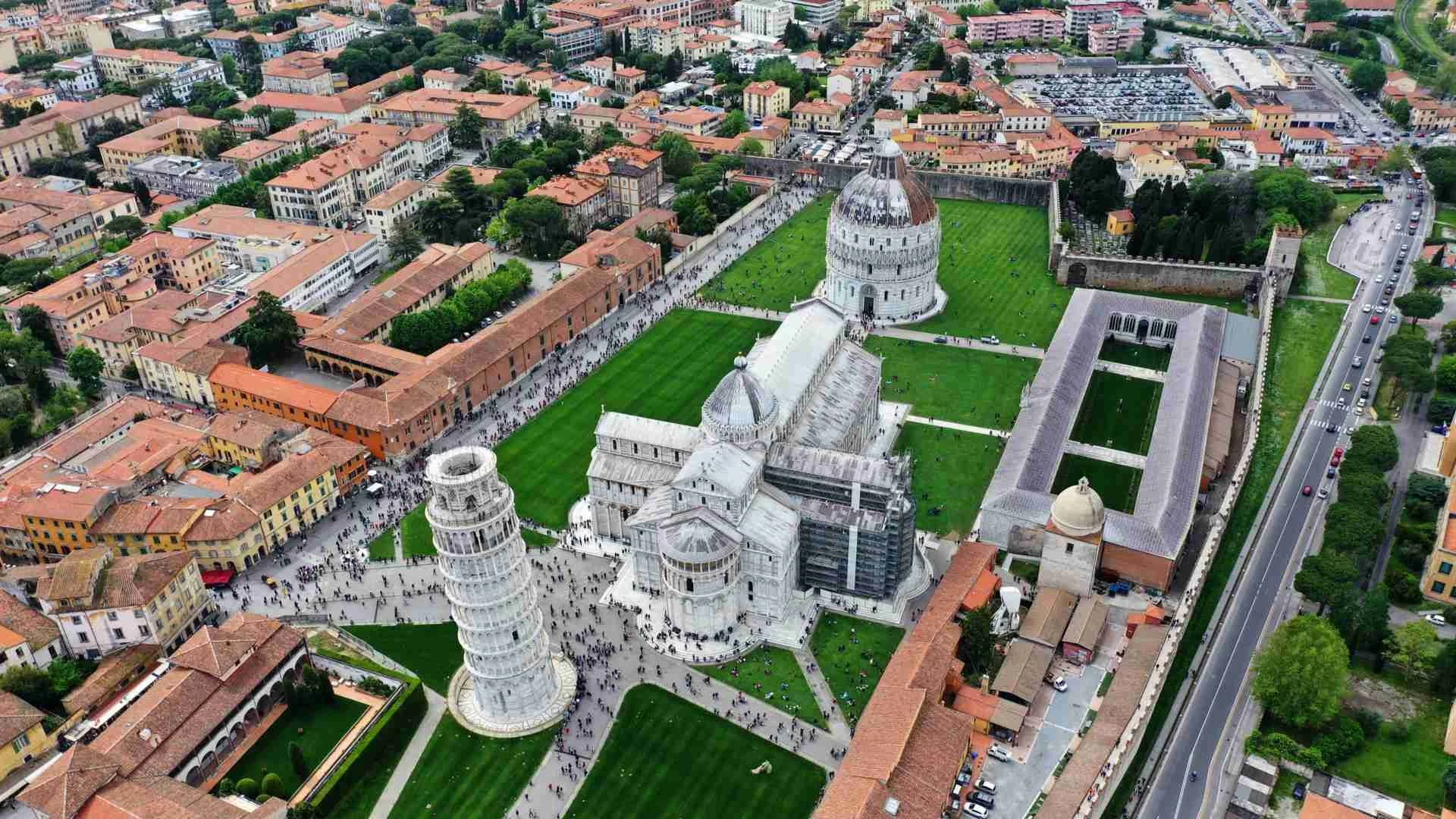
Four architectural masterpieces dominate the luminous expanse of green lawn that characterizes the square. The Cathedral of Santa Maria Assunta (1064-1118) anchors the composition as the spiritual centerpiece. The circular Baptistery (1152-1363), the largest in Italy, demonstrates the transition from Romanesque to Gothic styles across its two-century construction. The Camposanto Monumentale (begun 1278), or Monumental Cemetery, houses important frescoes and Roman sarcophagi within its cloistered walls, reputedly built around sacred soil brought from Golgotha during the Crusades. Finally, the Campanile—universally known as the Leaning Tower of Pisa (1173-1372)—achieves iconic status through its unintended tilt.
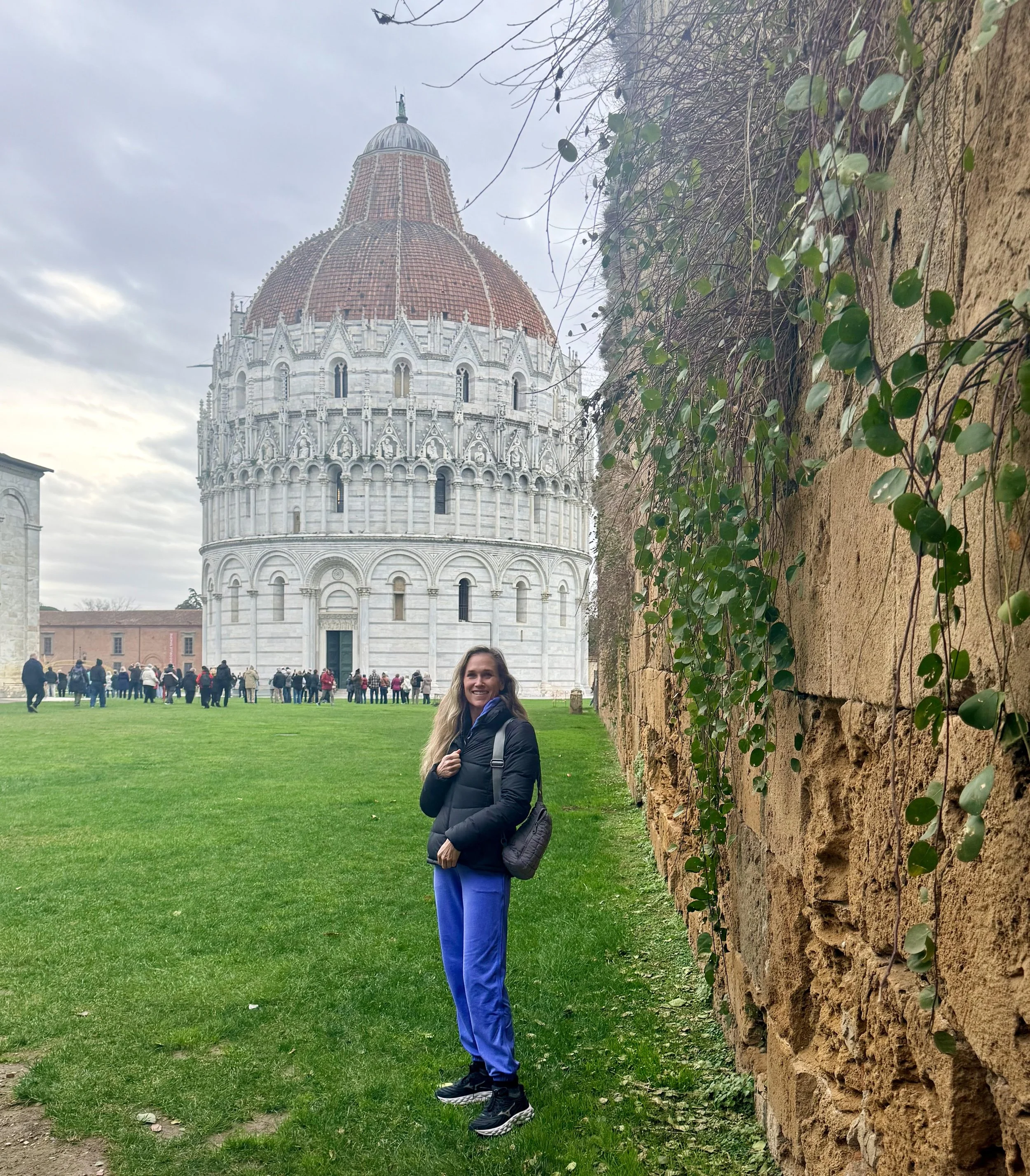
A grey, cold day but wowed by the architectural tour, nonetheless. Pisa, Italy
The Cathedral of Santa Maria Assunta
The layout itself is remarkable: rather than following a rigid axial plan, the buildings are arranged asymmetrically on a vast lawn, creating dynamic visual relationships from every angle. The consistent use of white and grey marble with black inlay across all structures creates visual harmony, while each building maintains its distinct character. This architectural ensemble represents not merely individual monuments but a unified vision of medieval Christian cosmology rendered in stone.
Beyond the four primary structures, the square also contains the Museo dell'Opera del Duomo, which houses original sculptures and artwork from the cathedral complex, and the Museo delle Sinopie, displaying preparatory drawings for the Camposanto's frescoes.
The Cathedral of Santa Maria Assunta, formally designated as the Duomo di Pisa, represents a seminal example of Pisan Romanesque architecture within the UNESCO World Heritage Site of Piazza dei Miracoli. The edifice was founded in 1064 CE, with consecration occurring in 1118 CE under Archbishop Dagobert.
Architectural development proceeded in two principal phases. The initial phase, executed under the direction of architect Buscheto, established the foundational structure and core design elements. Subsequent expansion was undertaken by architect Rainaldo, who notably designed the facade, completed circa 1180 CE.
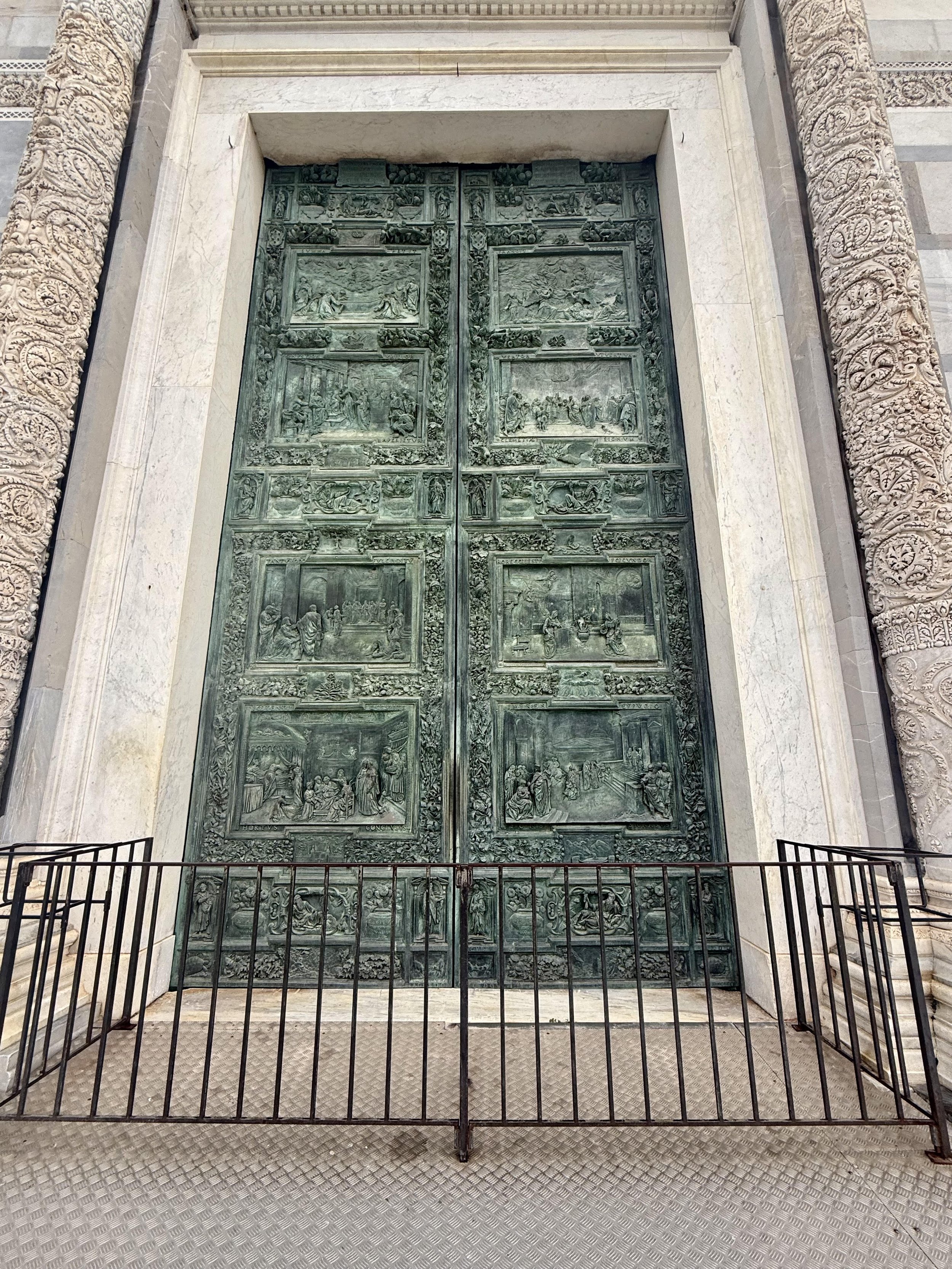
A conflagration in 1595 CE resulted in substantial interior damage, necessitating extensive restoration that introduced limited Baroque interventions while preserving the essential Romanesque character. The exterior exhibits a distinctive polychrome marble pattern of alternating dark and light bands, a decorative motif reflecting Islamic architectural influence transmitted through Pisa's Mediterranean trade networks. Interior decorative programs include significant early 14th-century mosaic work, exemplified by the apsidal Christ in Majesty attributed to Cimabue (completed 1302).
Of ethnographic interest is the folk tradition surrounding metallic fragments embedded in the northern exterior wall, colloquially termed the 'Devil's Nails' (Unghie del Diavolo). These elements, likely remnants of earlier construction or repurposed Roman materials, are subject to local legend asserting their enumeration yields inconsistent results, a phenomenon attributed in popular tradition to supernatural agency.
Leaning Tower of Pisa
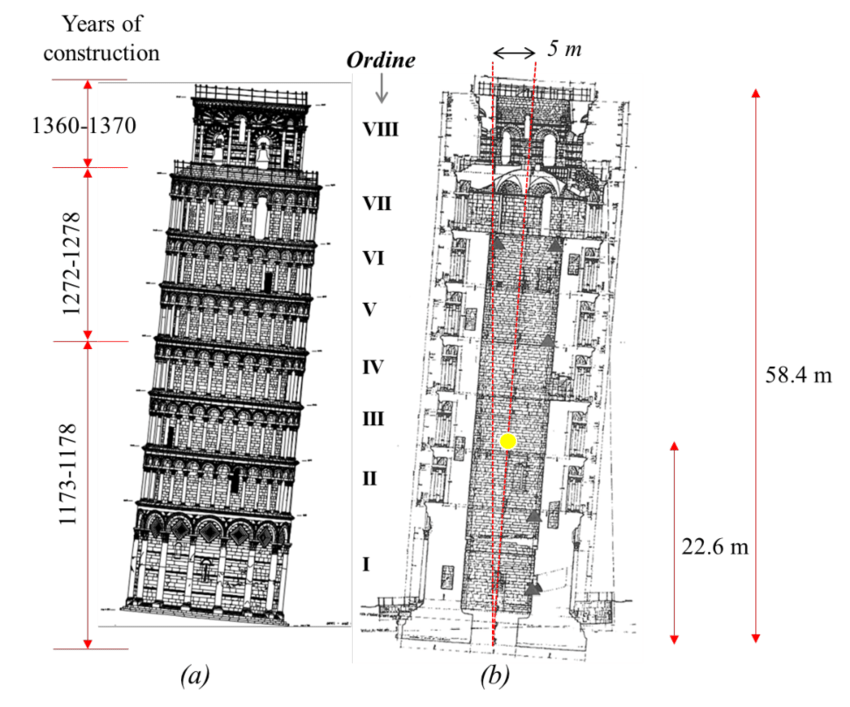
The Leaning Tower of Pisa stands as one of Italy's most iconic landmarks, famous for its unintended tilt of approximately 3.97 degrees from vertical. Construction of this freestanding bell tower (campanile) began in August 1173 as part of the cathedral complex in Pisa's Piazza dei Miracoli. Almost immediately, the structure began tilting due to soft clay, fine sand, and shells comprising the inadequate foundation—a geological challenge builders didn't anticipate.
The tower's construction spanned nearly 200 years, interrupted multiple times as engineers attempted to compensate for the increasing lean. These correction efforts resulted in the tower's distinctive curved appearance, with upper floors built at an angle to counteract the tilt. By the time the bell chamber was completed in 1372, the structure had developed its characteristic “kink.”
The tower houses seven bells, each tuned to a musical scale, but they've remained silent since 2001. Authorities banned bell-ringing to prevent vibrations that could accelerate structural deterioration. Between 1990 and 2001, extensive stabilization work reduced the tilt by 45 centimeters, ensuring the tower's survival for at least another 200 years.
Today, visitors can ascend the tower's 251 steps (294 if counting from ground level) to reach the bell chamber, though children under 8 are prohibited and those under 18 must be accompanied by an adult. The classic photographic perspective—appearing to hold up the tower—is best captured through the archway of Porta Santa Maria on the piazza's southern side.
The Baptistery of St. John (Battistero di San Giovanni)
The Baptistery of St. John (Battistero di San Giovanni) stands as the largest baptistery in Italy and represents one of the most acoustically remarkable buildings in the world. Construction began on August 15, 1152, under the direction of architect Diotisalvi, whose signature appears in an inscription inside the building: "1153, in the month of August, this work was begun by Diotisalvi."
The building's construction spanned over two centuries, reflecting the evolution of architectural styles in medieval Italy. Diotisalvi's original Romanesque design was later modified by the sculptor-architect Nicola Pisano, who introduced Gothic elements in the mid-13th century. His son, Giovanni Pisano, continued the work in the late 13th and early 14th centuries, adding the upper gallery and completing the distinctive pinnacles and statuary that crown the building.
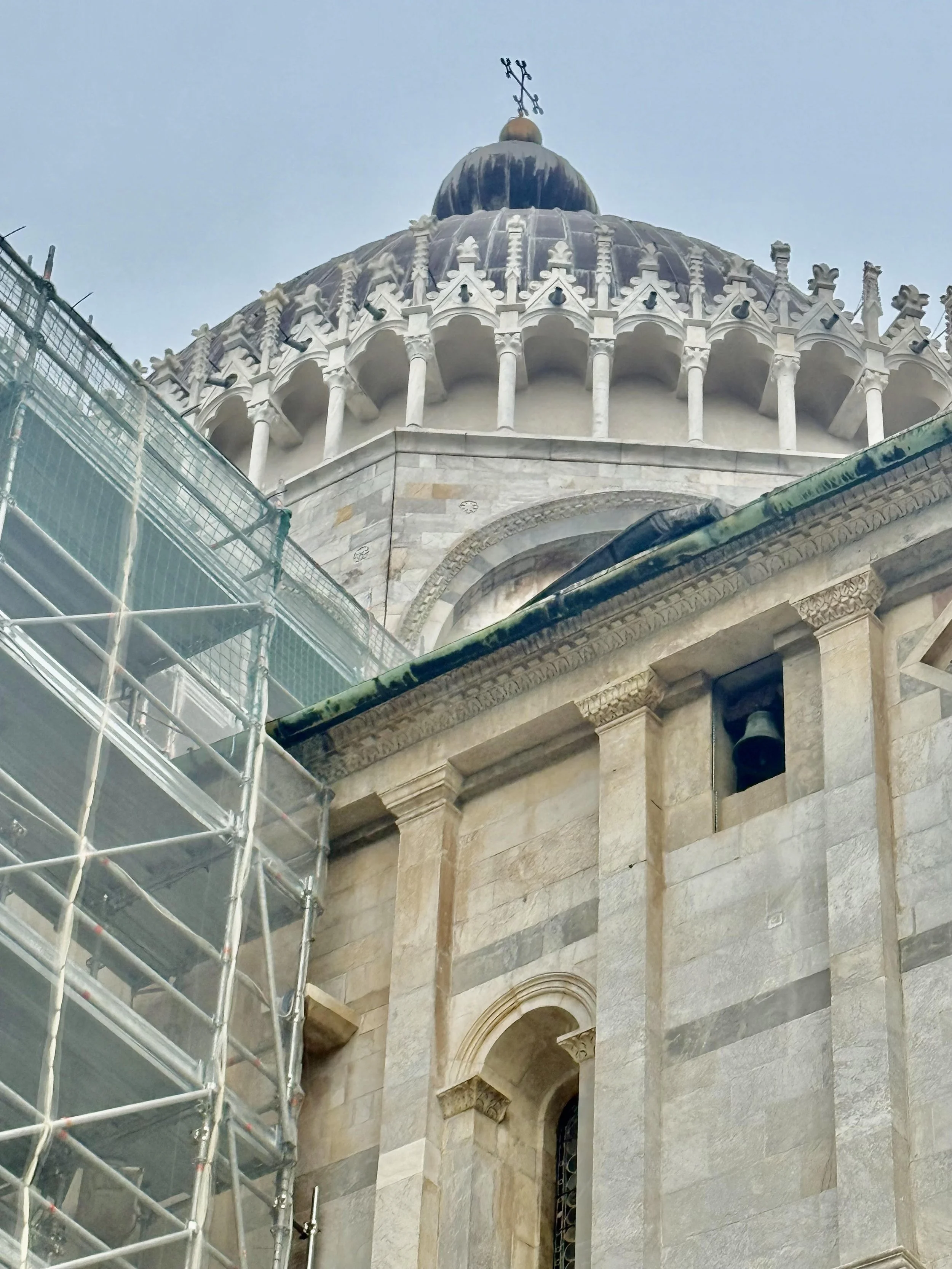
The baptistery's dimensions are imposing: it measures 107.24 meters in circumference and reaches 54.86 meters in height—taller than the famous Leaning Tower beside it. The structure is essentially circular, built on a foundation designed to counteract the same soft soil that caused the tower's tilt. Despite these precautions, the baptistery itself leans approximately 0.6 degrees toward the cathedral.
The dome presents a unique dual covering: red terracotta tiles face west toward the sea and the port that made Pisa wealthy, while lead sheets cover the eastern half. Scholars debate whether this represents an incomplete project, a deliberate aesthetic choice, or simply practical considerations related to different construction phases. The contrast creates a distinctive visual effect when viewed from different angles around the piazza.
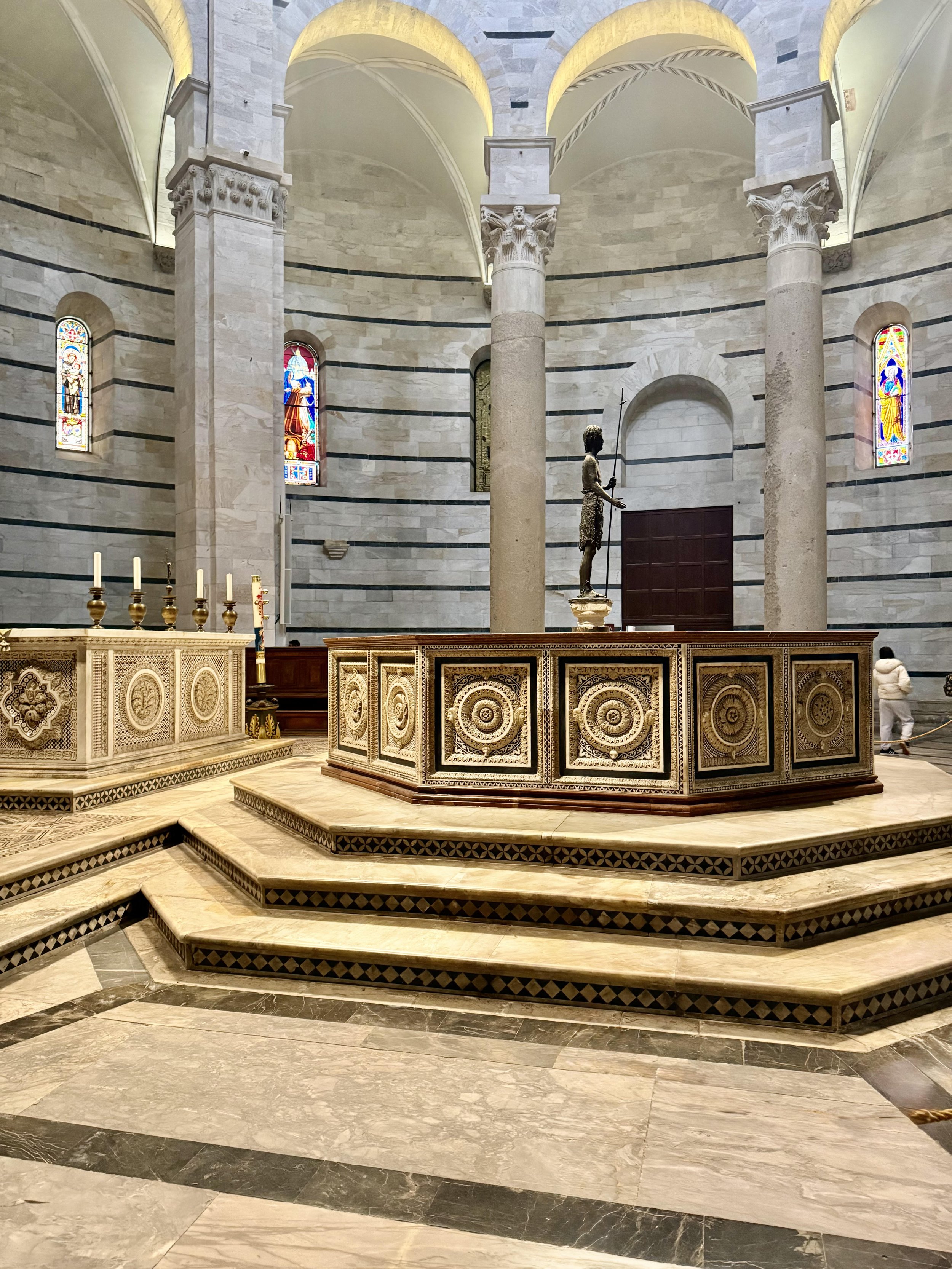
Inside, the baptistery's architectural marvel truly reveals itself. The building features a double dome—an inner hemispherical dome and an outer conical dome—creating a cavity that produces extraordinary acoustic properties. The circular interior, combined with the hard marble surfaces and the resonant space between the two domes, creates reverberation times of up to 15 seconds for certain frequencies. This acoustic phenomenon transforms even simple sounds into ethereal, otherworldly echoes.
A must do! To demonstrate this remarkable feature, staff members regularly perform acoustic demonstrations, typically every 30 minutes during visiting hours. They sing single notes or simple phrases, and visitors experience how the sound swells, multiplies, and sustains in harmonic layers, creating the effect of a full choir from a single voice. The acoustics were intentionally designed to enhance liturgical chanting and to create an awe-inspiring atmosphere during baptismal ceremonies.
The interior also houses Nicola Pisano's magnificent pulpit (1255-1260), considered a masterpiece of medieval sculpture and a forerunner of the Renaissance. The octagonal baptismal font at the center, though replaced in 1246, maintains the building's original liturgical function.