What Textbooks Can't Teach: My 24 hour Journey to Ancient Rome
Since earning a Classics minor as an undergraduate, I've been captivated by ancient Rome—its political structures, military tactics, art, architecture, and pottery. While I've studied Roman monuments, sculptures, and ceramics in textbooks, nothing compares to experiencing their scale, texture, and color in person. Standing in one of the world's oldest cities, surrounded by structures preserved in situ, offers insights no textbook can provide. What follows is my journey to ancient Rome:
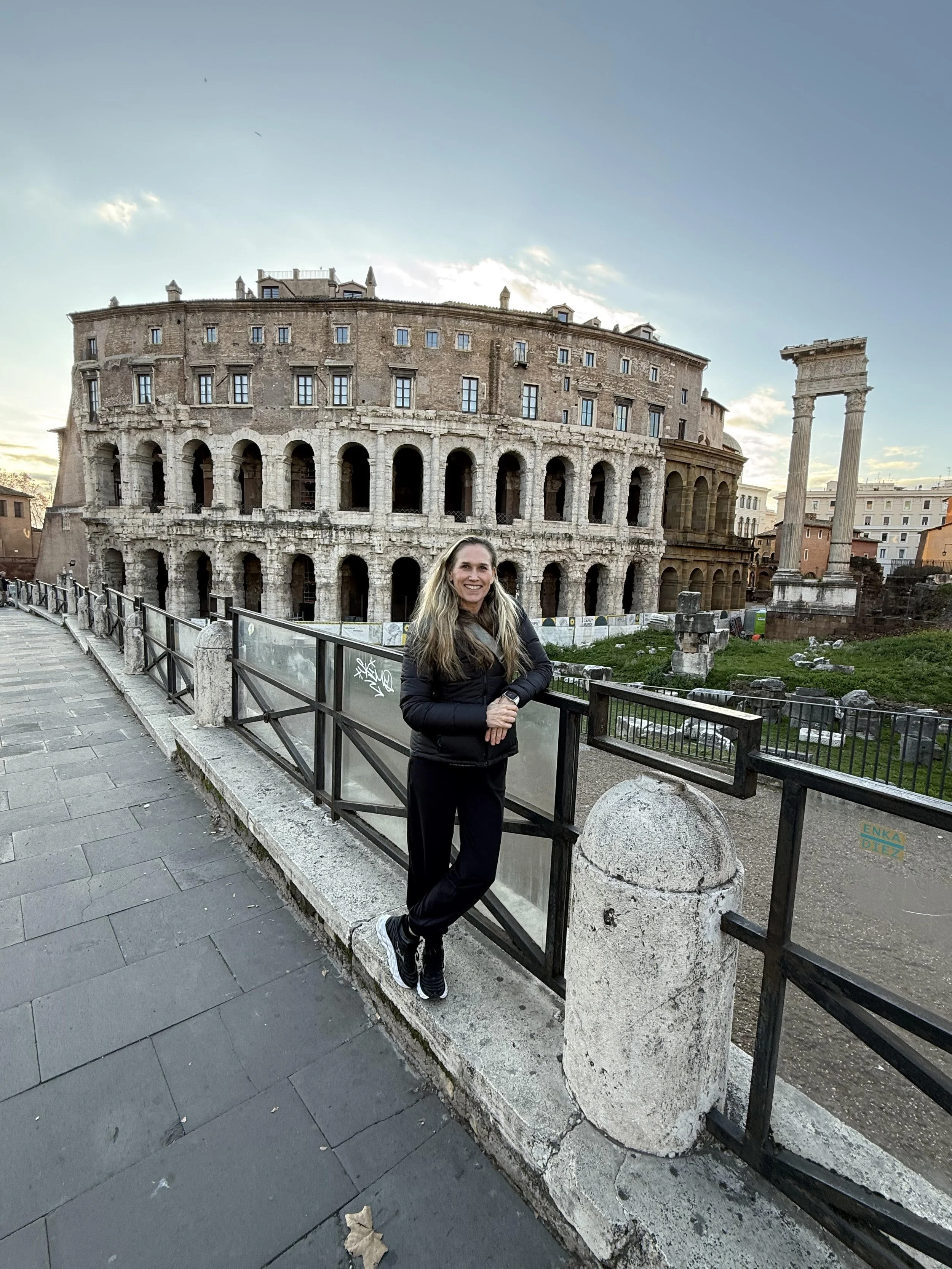
Rebekah Jacob in front of Circus Maximus, Rome, Italy
“Rome is not like any other city, it’s a big museum, a living room that shall be crossed one’s toes.” - Alberto Sordi
Rome - An Open Air Museum
Rome itself functions as a massive open-air museum, showcasing ancient ruins, Renaissance art, and modern street art. My personal favorite open-air sites include the following — and I hope to return to Rome sooner than later to add to the working list:
Trevi Fountain
The Trevi Fountain is one of 1,352 fountains built in Rome over the centuries and has always stood out from the rest. In ancient Roman times, the construction of the Aqua Virgo Aqueduct provided water to the Roman baths and fountains of central Rome. Legend says the Aqua Virgo, or Virgin Waters, is named in honor of a young Roman girl who led thirsty soldiers to the source of the spring.
The fountain was built at the endpoint of the aqueduct, at the junction of three roads (tre vie), giving the Trevi Fountain its name: the Three Street Fountain.
Arguably the most beautiful and certainly the largest fountain in Rome, the Trevi Fountain measures 26 feet tall and 49 feet wide. It was constructed with travertine stone during the Renaissance. The final appearance dates from 1762, when after many years of work by Nicola Salvi, it was completed by Giuseppe Pannini under the direction of Pope Clement XII. After a prolonged closure for refurbishment funded by the fashion house Fendi (who reportedly spent $2.2 million), the fountain was unveiled again, better than ever.
To throw a coin in Rome's Trevi Fountain, stand with your back to the fountain and toss a coin with your right hand over your left shoulder while making a wish. One coin means you'll return to Rome, two coins mean you'll find love, and three coins mean you'll marry. The collected money benefits charity.
Circus Maximus
Circus Maximus was the largest chariot stadium in ancient Rome. The 600-meter-long stadium, located between the Palatine and Aventine hills, could accommodate as many as 150,000 spectators. The first construction dates back to the 6th century BC, after which several emperors expanded or rebuilt the stadium following major fires.
Little remains of the old stadium today. You'll find a large field where the shape is still recognizable and a few small ruins. The Circus Maximus was in use until 549 AD. After its decline, the stands were demolished so the stones could be reused for new churches and palaces. In the 20th century, the site was filled with industrial buildings, but Mussolini had them demolished to use the area for large public events.
For many tourists, Circus Maximus is not spectacular to visit, but if you're nearby, it's a historic place where you can get an impression (with some imagination) of the huge stadium, which was much larger than the Colosseum. Now only a small part of the southeast stand remains, along with a few arcades, though the contours are clearly visible on the large grassy area. The two large obelisks that once stood on the site have been moved: Augustus' obelisk now stands in Piazza del Popolo, and that of Constans II stands next to the Basilica of St. John Lateran.
Various activities took place in the Circus Maximus, the most famous being horse-drawn chariot competitions, mostly driven by slaves who could fight for their freedom by winning. Other activities included simulations of famous battles conducted by young Roman aristocrats, gladiator fights, and athletic competitions.
Pantheon
French writer Stendhal described it in the 19th century as "the most beautiful relic of ancient Rome, a temple so well preserved that it appears as the Romans must have seen it in their times." A source of inspiration for the greatest architects of all ages, its beauty, harmony of lines, and perfect geometries have struck people throughout history.
The story of one of the best-preserved examples of Roman monumental architecture begins in 27 BC, when Marcus Vipsanius Agrippa, a close friend, son-in-law, and lieutenant to Augustus, commissioned a temple dedicated to "all the gods." The present building, however, is the result of radical reconstruction by Hadrian between 118 and 125 AD, who expanded it, reversed its orientation, and opened a large square with a portico in front.
Having fallen into neglect and subsequently sacked by barbarians, in 609 AD it was donated by Byzantine Emperor Phocas to Pope Boniface IV, who consecrated it as Santa Maria ad Martyres, thus preserving it from the spoliation that affected many other ancient monuments in medieval times. The Basilica houses the ancient Byzantine icon of the Virgin and Child that Emperor Phocas donated to Pope St. Boniface IV on the occasion of the dedication.
In 1625, under Pope Urban VIII Barberini, the bronze coatings of the portico were removed to create the canopy of St. Peter's and cannons for Castel Sant'Angelo. Barberini's name became forever linked to a popular saying: "Quod non fecerunt barbari, fecerunt Barberini"—what the barbarians didn't do, the Barberinis did. In the same years, two bell towers were built on the sides of the front, which the Romans scornfully called "donkey's ears"; these were removed after Italian unification. In 1870, the Pantheon was turned into a memorial chapel for the kings of Italy. The tombs of Vittorio Emanuele II, Umberto I, and Margherita of Savoy are found here, along with that of the famous artist Raphael.
The building consists of a cylindrical structure preceded by a portico with Corinthian columns supporting the pediment. The original inscription with the dedication to Agrippa is preserved on the frieze. The large circular cell is surrounded by thick masonry walls and eight large pylons on which the weight of the characteristic hemispherical concrete dome is distributed—larger than that of St. Peter's Basilica. What is most surprising about the Pantheon's architecture is its size: the height of the building equals the diameter of the dome, just over 43 meters, a feature reflecting the classic canons of Roman architecture.
The dome features sunken panels, or coffers, in five rings of 28 (a number considered perfect because it equals the sum 1+2+3+4+5+6+7). At the center opens an oculus 8.92 meters in diameter, the only natural source of light in the interior. During the summer solstice, the ray of sun entering through the large eye of the dome projects a huge luminous disk on the floor with a diameter equal to that of the oculus. During storms, a drainage system below the floor, made of 22 drainage holes, handles the rain that falls through the oculus. Circles and squares form the unifying theme of the interior design.
On the day of Pentecost every year, a rain of rose petals falls from the oculus at the end of the Corpus Christi celebration.
Galleria Sciarra
A period of urban transformation and modernization began after the proclamation of Rome as the capital of Italy. Among the areas affected by renovation was the 16th-century compound between Via del Corso, Via Marco Minghetti, and Via delle Vergini, a few steps from the Trevi Fountain.
The project involved the construction of a covered walkway connecting all the different activities of Prince Maffeo Barberini-Colonna di Sciarra, deputy of the Kingdom of Italy and columnist for La Tribuna and the famous literary magazine La Cronaca Bizantina, directed by Gabriele D'Annunzio.
At the end of the works, one of the most prestigious courtyards of post-unification Rome emerged: a real jewel of Roman Art Nouveau set in the imposing Palazzo Sciarra Colonna di Carbognano, built between the 16th and 17th centuries. The palace has one of the most beautiful access gates in the city, known as one of the four "wonders of Rome." The other three were the 'dice' (the square shape of Palazzo Farnese), the 'cymbal' (that of Palazzo Borghese), and the 'staircase' (the monumental stair of Palazzo Ruspoli with its 120 single marble blocks).
The execution of the project was entrusted to Giulio De Angelis, the most unique, innovative, and restless Roman architect of the time, already known for constructing the Rinascente palace.
Fascinated by English Art Nouveau style, De Angelis designed a square-plan structure enclosed by an iron and glass vault, with cast-iron columns marking the access to the passages between Via Minghetti and Piazza dell'Oratorio, and references to classicism in the architecture and wall decorations.
The central body was painted in encausto, a technique using pigments mixed with Punic wax, by Giuseppe Cellini between 1885 and 1888. The decoration with Art Nouveau motifs and Etruscan and Roman reminiscences was based on literary critic Giulio Salvadori's iconographic project.
The dominant theme celebrated women as angels of the hearth and as brides and mothers in the bourgeois vision of late-19th-century society. In the upper part of the passage, a scroll identifies the Virtues: Modesty, Sobriety, Strength, Humility, Prudence, and Patience; on the opposite side, Benign, Lady, Lovable, Faithful, and Merciful. In the lower band, scenes of bourgeois life depict, on one side, Tending the Garden, Conversation, Lunch at Home, Musical Entertainment, and Exhortation to Charity; on the other, The Courteous Conversation (which portrays Gabriele D'Annunzio), Vanity, Marriage, and Care of Children.
The decorations, which especially exalt the mother of the Prince, Donna Carolina Barberini Colonna di Sciarra, repeat the initials of Princess CCS alternating with those of her son, MS.
The works ended in 1888. The substantial restoration of the Gallery in the 1970s saw the entire structure emptied and then consolidated with reinforced concrete. All exterior decorations were carefully preserved.
Church of Sant'Ignazio di Loyola
The Church of Sant'Ignazio di Loyola was built on a design by Jesuit mathematician Orazio Grassi, based on the plans of Carlo Maderno and others, and at the expense of Cardinal Ludovico Ludovisi, nephew of Pope Gregory XV, as the inscription on the facade recalls. The facade is inspired by that of the nearby Church of Gesù, with two orders of pilasters and Corinthian columns, enriched by large windows, niches with tympanum, and folders.
The interior, in the shape of a Latin cross, has three chapels on each side that intercommunicate. The polychromy of the marble, the stuccoes, the pictorial decoration, and the richness of the altars give the whole a sumptuous appearance.
The decorations on the ceiling of the grandiose vault of the nave are by Andrea Pozzo, a Jesuit brother, and represent The Rise of Saint Ignatius into Paradise.
Also by Andrea Pozzo is the false dome located at the crossroads of the transept. It is a canvas 13 meters in diameter on which Pozzo created the perspective effect of fake architecture. The original painting, completed in 1685, was destroyed by fire; in 1823 it was faithfully reproduced by Francesco Manno based on drawings and studies left by Pozzo.
Worth admiring is the Monument to Pope Gregory XV, a late-17th-century work situated in the room to the right of the apse, and the gigantic Statue of St. Ignatius, a work by Camillo Rusconi dated 1728, situated in the room to the left of the apse. Also worthy of note is the square overlooked by the church, built in rococo style by Filippo Raguzzini (1727-28).